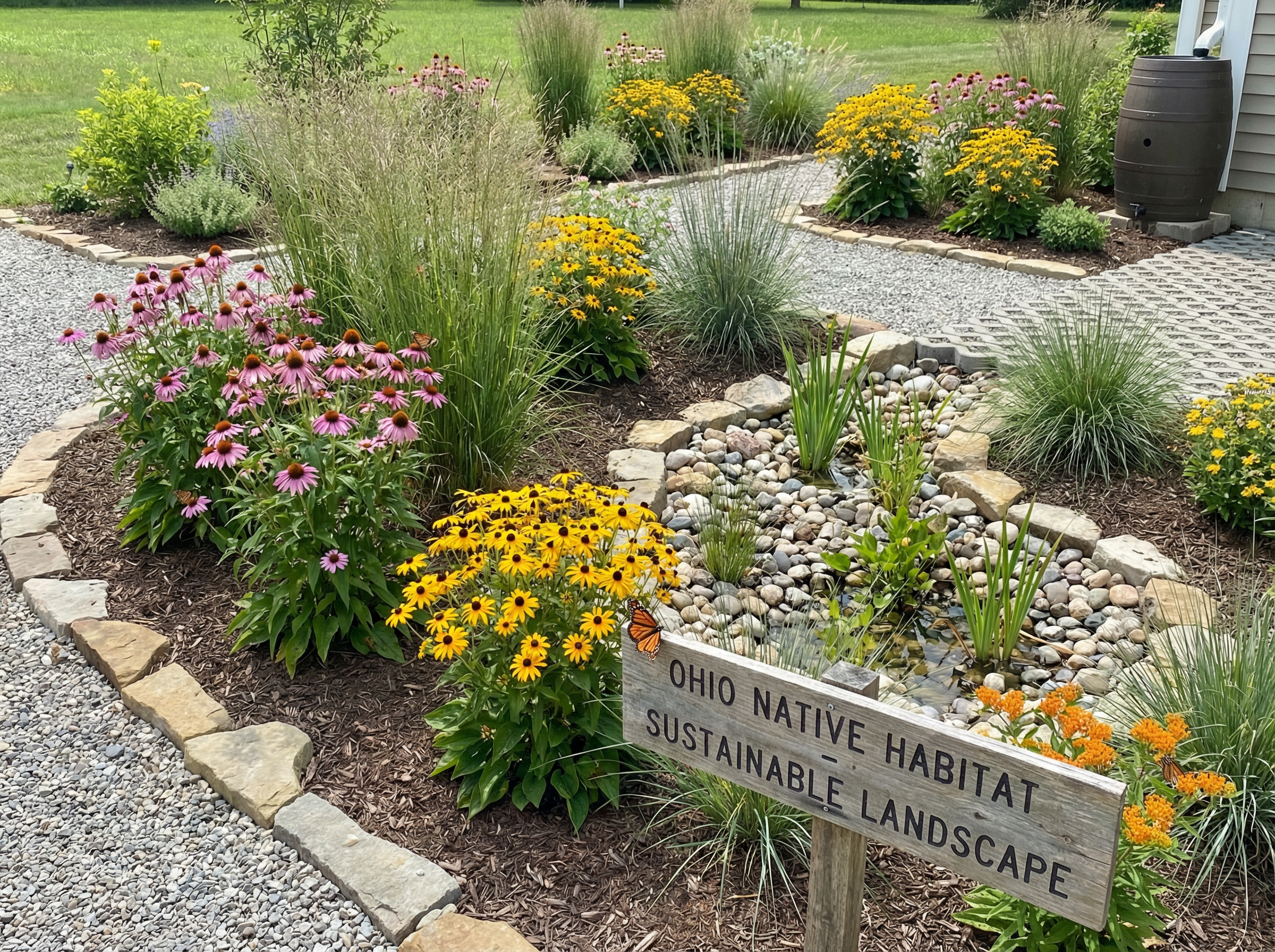
There's a growing movement in residential landscaping toward native plants — and for good reason. Native plants are adapted to Ohio's climate, soil, and rainfall patterns. They require less water once established, support local wildlife, and tend to be significantly more resilient than non-native alternatives.
Here's a practical guide to incorporating native Ohio plants into your Warren County landscape.
Why Native Plants Make Sense for Ohio Homeowners
Ohio's climate is variable — hot, humid summers, cold winters, and spring weather that can swing 40 degrees in a week. Native plants have evolved to handle all of it. They've developed root systems suited to Ohio's clay-heavy soils, tolerance for the freeze-thaw cycles that damage less-adapted plants, and resistance to the pests and diseases common in this region.
The practical result: once established, native plants require dramatically less intervention than non-native ornamentals. Less watering, less fertilizing, fewer pest treatments.
Top Native Plants for Warren County Landscapes
Ohio Buckeye (Aesculus glabra)
The state tree is also an excellent landscape specimen. It provides dense shade, attractive spring flowers, and distinctive fall color. Best suited for larger properties where it has room to reach its mature size of 20–40 feet.
Black-Eyed Susan (Rudbeckia hirta)
One of the most reliable native perennials for Ohio gardens. It blooms from June through October, tolerates drought once established, and attracts pollinators. Works well in both formal and naturalistic plantings.
Wild Blue Indigo (Baptisia australis)
A long-lived perennial with striking blue-purple flowers in spring and attractive seed pods through fall. Extremely drought-tolerant once established and virtually pest-free. Slow to establish but worth the wait.
Switchgrass (Panicum virgatum)
A native ornamental grass that provides four-season interest — airy summer texture, golden fall color, and winter seed heads that feed birds. Tolerates wet and dry conditions and is excellent for erosion control on slopes.
Eastern Redbud (Cercis canadensis)
One of Ohio's most beautiful native trees, with spectacular pink-purple flowers that appear before the leaves in early spring. Mature size of 20–30 feet makes it suitable for most residential lots. Tolerates partial shade.
Designing with Natives: Practical Considerations
Native plants don't mean a wild, unmaintained look. The key is thoughtful design — selecting plants that work together in terms of scale, bloom time, and texture, and placing them in conditions that match their natural habitat.
A few principles that guide our native plant designs:
- Match plant to site conditions. A plant that naturally grows in wet meadows will struggle in a dry, sunny border. Match the plant to the conditions you have rather than trying to change the conditions to suit the plant.
- Layer the planting. Natural plant communities have canopy, understory, shrub, and ground layer plants. Layered plantings look more natural, provide more wildlife habitat, and are more resilient.
- Plan for the first two years. Native plants invest in root development before visible top growth. The first season often looks underwhelming. By year three, most natives are thriving with minimal care.
Native Plant Landscaping in Springboro and Warren County
Southern Landscape Management incorporates native plants into landscape designs throughout Springboro, Centerville, Miamisburg, and surrounding Warren County communities. If you're interested in a more sustainable, lower-maintenance landscape, contact us for a consultation.