
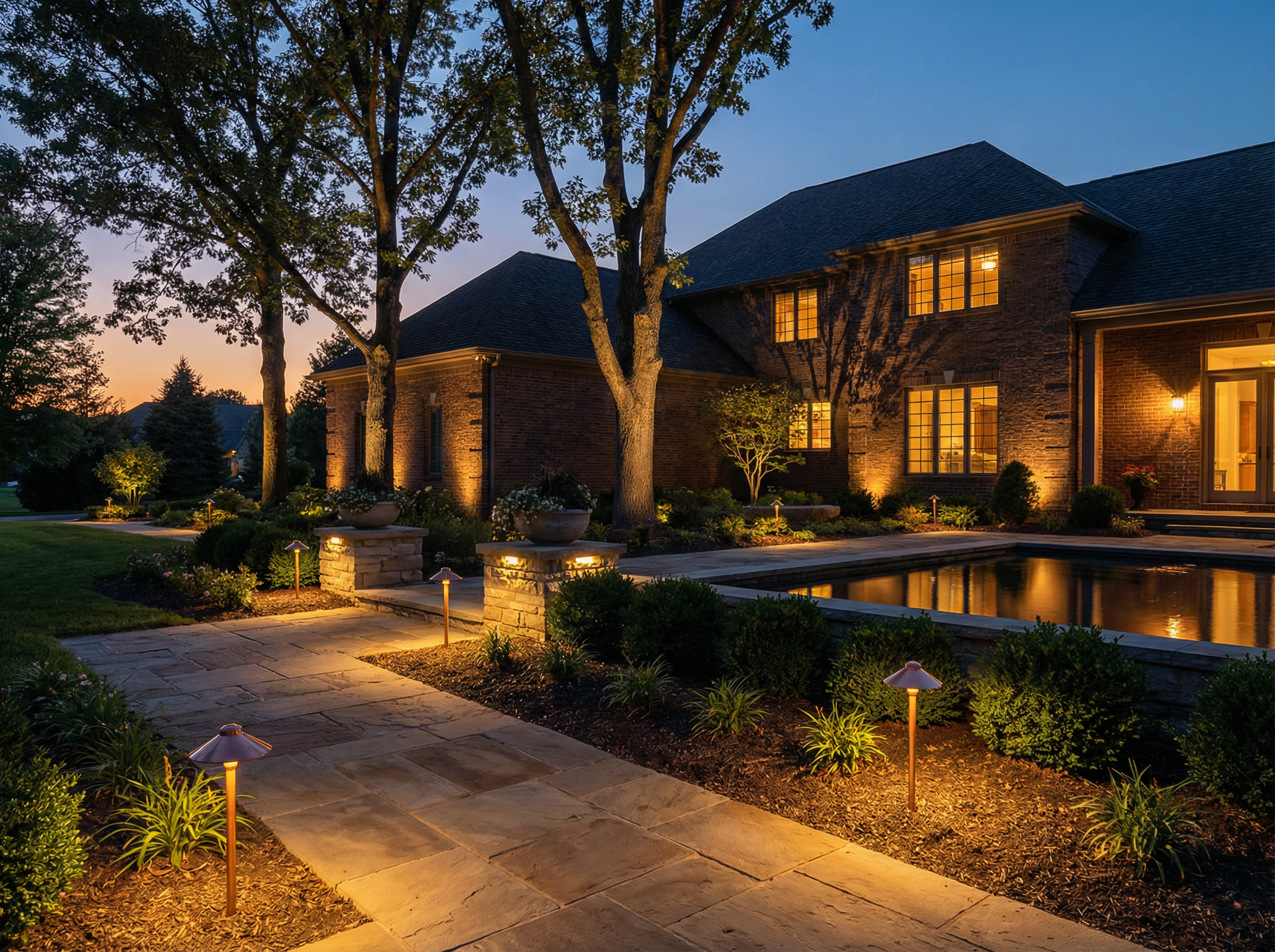
Landscape lighting is one of the highest-ROI upgrades a Springboro homeowner can make. It extends your outdoor living hours, improves security, dramatically increases curb appeal after dark, and — when done well — transforms a good landscape into a great one.
Here's what you need to know before you start planning your outdoor lighting project.
The Three Goals of Landscape Lighting
Good outdoor lighting serves three purposes simultaneously: safety, security, and aesthetics. A well-designed system addresses all three rather than optimizing for just one.
- Safety means illuminating steps, grade changes, pathways, and entry points so people can move around your property without risk.
- Security means eliminating dark zones where someone could approach the house undetected. Motion-activated lighting at entry points and along the perimeter is the most effective approach.
- Aesthetics means using light to highlight the features you want people to notice — architectural details, specimen trees, garden beds, water features.
Lighting Techniques That Work
Uplighting
Placing fixtures at ground level and aiming them upward at trees, shrubs, or architectural features creates dramatic shadow and depth. This is the most commonly used technique for specimen trees and building facades.
Path Lighting
Low-profile fixtures along walkways and driveways serve both safety and aesthetic functions. The key is spacing — fixtures placed too close together create a runway effect. Proper spacing creates a gentle, inviting glow.
Downlighting
Fixtures mounted in trees or on structures and aimed downward create a natural moonlight effect. This is particularly effective for patios and seating areas where you want ambient light without harsh glare.
Accent Lighting
Spotlights aimed at specific features — a garden sculpture, a water feature, a distinctive plant — draw the eye and create focal points in the landscape at night.
LED vs. Traditional Landscape Lighting
LED is the right choice for almost every new installation. The upfront cost is slightly higher, but LEDs last 25,000–50,000 hours versus 2,000–4,000 hours for halogen. They use 75–80% less energy, run cooler (which matters for plants and mulch), and the color quality has improved dramatically in recent years.
If you have an existing halogen system, retrofitting to LED is usually straightforward and pays for itself in energy savings within a few years.
Common Mistakes to Avoid
- Over-lighting. More fixtures doesn't mean better results. Too much light creates glare, washes out the landscape, and looks commercial rather than residential.
- Ignoring the neighbors. Fixtures aimed incorrectly can create light pollution that affects adjacent properties. Aim fixtures carefully and use shields where needed.
- Skipping the transformer. Undersized transformers are the most common cause of landscape lighting failures. Size your transformer for the system you have plus 20% for future expansion.
- Forgetting maintenance access. Fixtures buried under plants or installed in locations that are difficult to reach become a problem when bulbs need replacement or fixtures need adjustment.
Outdoor Lighting Installation in Springboro, Ohio
Southern Landscape Management designs and installs landscape lighting systems for residential properties throughout Springboro, Centerville, Miamisburg, and Warren County. We handle everything from design through installation and can integrate new lighting with existing systems. Contact us for a free consultation.